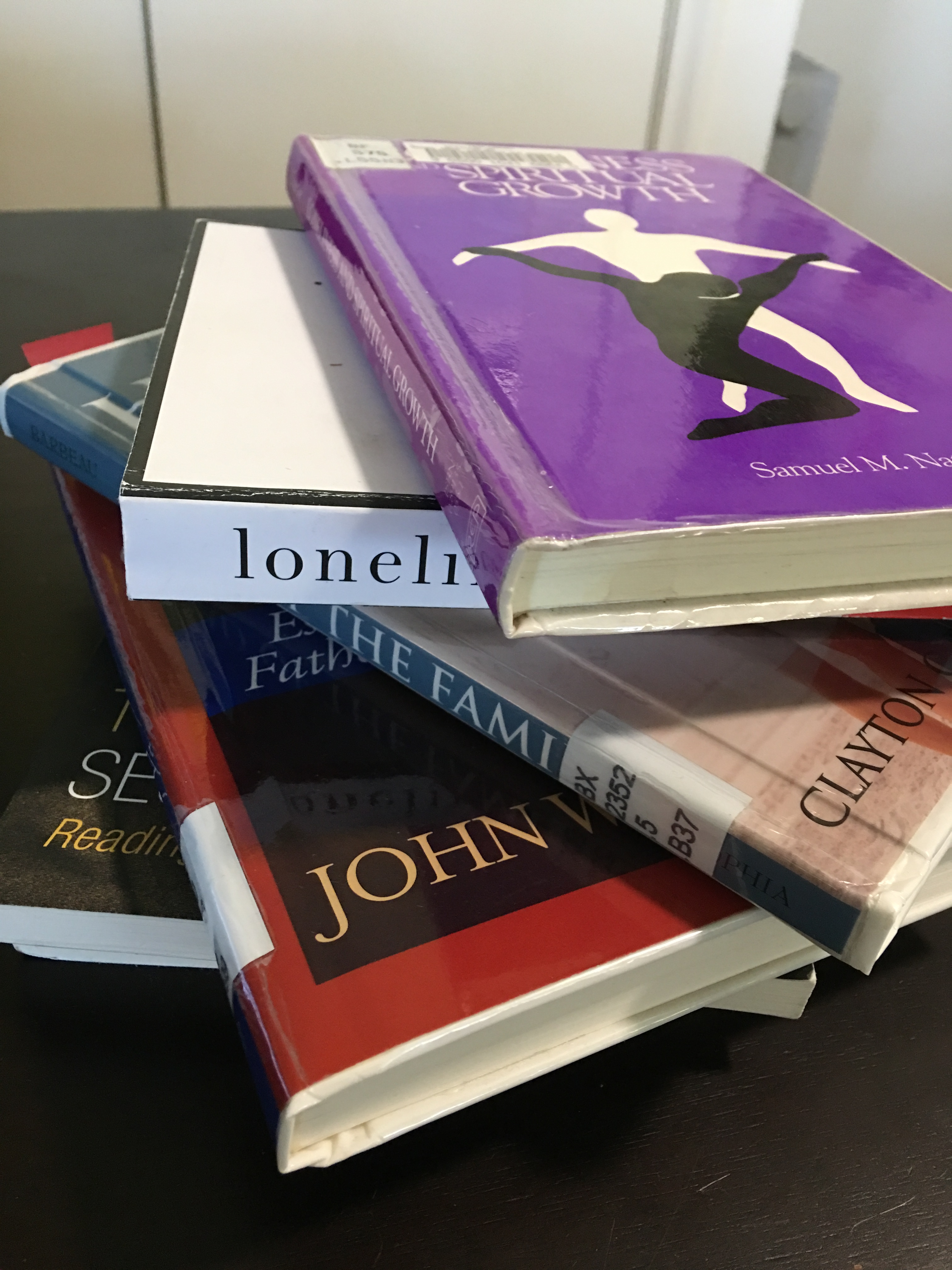
Theological Sources
Kasper, Walter. Mercy: The Essence of the Gospel and the Key to Christian Life. New York: Paulist, 2014.
As a Christian, this book is very meaningful to help understand deeply the meaning of mercy as hesed with the idea that we don’t deserve to receive the loving kindness, favor and friendliness of God, but it is through his grace and love. Kasper gives insights and challenges to make a difference between the sinner and sin: to love the sinner and hate the sin, to open a future for life and blessings with physical and social dimension in human beings.
Smith, James K.A. How (Not) To Be Secular. Grand Rapids: Eerdmans, 2014.
This book inspires us to think about the world where we are and how we live today, which Smith calls Age of Authenticity. In this world, people live the Immanent Frame with self-sufficient humanism and expressive individualism with the cross-pressure of transcendence that today they are doubting about God and still longing for relationship with him, and the writer calls for reconversion of the Christianity.
Moltmann, Jürgen. In the End—The Beginning: The Life of Hope. Minneapolis: Fortress Press,2004.
I was drawn to the simple but powerful title the writer uses in his work in demonstrating an absolute truth through the lens of the living God, who calls us to life in the birth or death, in proclaiming that after the end there is a beginning. This book gives hope in the chaos we experience, empowers us to stand firm to overcome difficulties and talks about the possibility of challenging activities for old people to make them young.
Koester, Craig R. The Word of Life: A Theology of John’s Gospel. Grand Rapids: Eerdmans,2008.
This book mentions the particularity of the Gospel of John emphasizing about the only one true God, who gives life and raises the dead, Jesus as human being who died on the cross, and the meaning of his death, which is the fulfillment of God’s purpose for the world. Furthermore, Koester explains in his book how the Lamb of God, through his death, takes away the sin of the world and the foot washing is a tangible act anticipating the crucifixion.
Holt-Woehl, Hollie. “Creation and a Theology of Humanness,” Journal of Religion, Disability &Health 16:2 (2012): 121-132.
In this article, Holt-Woehl makes a difference between the “good” first Creation story, in which human beings are created like the image of God, and the second Creation story in the Garden of Eden, having the four conditions of creation: loneliness, limitations, temptations and anxiety, which are not the result of the sin, but just a human condition. She explains that to sin is a choice of all human beings, and how Jesus Christ is working to redeem us.
Moltmann, Jürgen. “The Crucified God: A Trinitarian Theology of the Cross.” Interpretation 26:3 (July 1972), 278-299.
The Crucified God hascreated a big discussion with many theologians and church members. Inspired by the significance of the Catholic tradition, Moltmann tries to clarify this subject with the idea of the Trinity through Paul’s theology about paredoken and concludesthat this is a work between God and God. The Father, the Son and the Spirit are crucified together.
Theoretical Sources
Albers, Robert H., William H. Meller, and Steven D. Thurber. Ministry with Persons with
Mental Illness and Their Families. Minneapolis: Fortress Press, 2012.
The book is the integration of psychiatry, psychology, and theology in work with people with mental illness. It gives basic knowledge about mental illness frequently occurs in society and in the ministry of the Church like depression, anxiety, different disorders, dementia, and autism to be able to minister to them efficiently with the cognitive behavioral therapy, prescription for medication in the severity of the illness, and the pastoral care.
Balswick, J. O., and J. K. Balswick. The Family: A Christian Perspective on the Contemporary Home. Grand Rapids, MI: Baker Academic, 2014.
The theology of relationship in the family based on the covenant unconditional love and extended grace, shared in this book, is a very key for the well-being of the members to free them to empower each other for the intimacy into a deep level of mature covenant commitment. Besides, the writers give another perspective on the contemporary home, explanation about marriage life, and more bout happy family.
Siegel, D. J., and T. P. Bryson. The Whole-Brain Child: 12 Revolutionary Strategies to Nurtureyour Child’s Developing Mind. New York: Bantam 2012.
This book is helping to know basic things about the brain of the child to help them grow, develop and reach their potential. Parents can use everyday moments with kids, a survive or a thrive moment through the precious work of parenting especially the difficult one, to help them to be more themselves, at ease everywhere they go, and filled with strength in of the feelings, emotions and thoughts in the brain.
Kegan, Robert, and Lisa Laskow Lahey. Immunity to Change: How to Overcome it and Unlockthe Potential in Yourself and Your Organization. Boston: Harvard Business Press, 2009.
Kegan gives a challenging work through the guidance with the Immunity Map to overcome the blockage that prevents our personal growth in the leading change with confidence and joy.
Kegan is giving a tool with four practical steps to work on the struggle of the personal change. After working on the personal level, we can diagnose also the blockage in the group that prevents them to grow though his immunity map.
Wright, N.T. After You Believe: Why Christian Character Matters. New York: Harper One, 2010.
Godly characters are important after Christians believe to live the resurrection of the new creation, says Wright, and it is not about a rule to follow to shape the behavior, but in becoming the human beings God meant to be. So, living with authenticity is crucial in Christian life, and we need to be prepared for the coming of the Kingdom not to be a classic Christian.
González, Justo L. The Story of Christianity, V 1: The Early Church to the Dawn of the Reformation. San Francisco: Harper & Row, 2010.
This story helps us to understand the early Catholic Church, which is the origin of the Christianity and the social, religious and political world of existence in the Judaic and Greco-Roman influence. The writer talks about the life of the monk, the Martyrdom and persecution in the Early Church, like the life of Polycarp, story of the defense of the faith through the controversy, and narration of monasticism in this book.
Practical Sources
Calhoun, Ahlberg Adele. Spiritual Disciplines Handbook: Practices That Transform Us.Downers Grove, IL: IVP, 2005.
This book is a guide for every day practice of spiritual discipline, presented for the well-being of the self through the spiritual life, self-discipline, self-care and rules for life to value the whole person, relationship with God, self, others and the earth. It is about a full restoration of the world.
Jones, W. Paul. Theological Worlds: Understanding the Alternative Rhythms of Christian Belief.Nashville: Abingdon Press, 1989.
Through the inventory, Jones helps to identify the five different worlds of Christian belief. In the description of the world IV- Condemnation and Forgiveness that fits me the best I understand my strength in my Christian life through the conversion. However, I discovered trough the weakness of this world that conversion is not the ending point of sanctification. This inventory helps Christians to work out their salvation.
Haley Barton, Ruth. Strengthening the Soul of Your Leadership: Seeking God in the Crucible of Ministry. Downers Grove, IL: InterVarsity Press, 2012.
Through this book, I learned the importance of the practice of quiet time in my everyday life as a Children of God and Christian leader. It helped me to enjoy a time of quietness before God early in the morning when I feel exhausted with the worry of life as I weak up. Also, it is a precious moment to listen to God’s voice in my doubts and the challenges of the day.
Osmer, Richard. Practical Theology: An Introduction. Grand Rapids: Eerdmans, 2008.
The four tasks of practical theology are really helpful to influence the change we wish in the challenging event. This tool is a guide used to collect information with the patterns of a specific situation, make appropriate interpretation though difference lenses, and through the theological concepts, build constructive normative task for better practice.
Heifetz, Ronald. Alexandra Grashow and Marty Linsky. The Practice of Adaptive Leadership:Tools and Tactics for Changing Your Organization and the World. Boston: Harvard Business Press, 2009.
In this leadership toward change, it is important to lead the self, to be in the balcony to observe objectively and on the practice field (dance floor) to listen and communicate with people to be able to intervene with the loss and challenges. The Adaptive Leadership has to do with the values, beliefs, anxiety and loyalties not with facts and logic of the head like fixing the technical problem.
Lund, Sarah Griffith. Blessed are the Crazy: Breaking the Silence about Mental Illness, Family& Church. St. Louis: Chalice Press, 2014.
The writer is very courageous to share her story to call the attention to what happens with the people who have mental illness and their family in telling her pain and suffering in living with a father who was maniac and how she managed her suffering through her spiritual life that she could proclaim the blessing for the crazy people.
Vanier, Jean. From Brokenness to Community. New York, Paulist Press, 1992.
Vanier talks about the power of the community in the gift of love and communion, the bound and care in mission for the healing. But, living in a community also is painful because it is a place of truth and growth where our pride, fear and brokenness are exposed.The writer mentions that we cannot open our hearts to others if we are not touched by God through those, we do minister.
Specialization Sources
Wimberly, Anne E. Streaty and Sarah Frances Farmer. Raising Hope: Four Paths to Courageous Living for Black Youth. Nashville:Wesley’s Foundery Books, 2017.
This book talks about the practice of ministry in the context of black youth to influence them to make a good choice in their struggle for a better future. It can be used by parents, pastors and educators to help them to build hope in the young black people in the present and future.
Conner, Benjamin T. Amplifying Our Witness: Giving Voice to Adolescents with Developmental Disabilities. Grand Rapids: Eerdmans, 2012.
Conner gives an extended view of youth ministry in welcoming young people with disabilities and helping them to have meaningful lives and hope for the future by offering to them a fullness as they are created in the likeness of God. The face of the Father is seen in those young people who have disabilities.
Root, Andrew. Relationships Unfiltered: Help for Youth Workers, Volunteers, and Parents on Creating Authentic Relationships. Grand Rapids: Zondervan, 2009.
Root explains that to make a space for young people to share about their success and failure in the youth ministry is a way to show love. Engaging in the full life of young people gives a meaning to youth ministry. This relationship is a tool to empower them to have self-confidence in what they do.
Drury, Amanda Hontz. Saying is Believing: The Necessity of Testimony in Adolescent Spiritual Development. Downers Grove, IL: Inner Varsity Press, 2015.
Drury talks about how the power of the testimony of faith shared with him impacted his young life and emphasizes that the Christian testimony shapes the present and the future in helping people to grow more in trusting God. Also, it is efficient in the faith formation of young people today for their spiritual development and is recommended to practice in youth ministry.
Root, Andrew. Taking Theology to Youth Ministry. Grand Rapids: Zondervan, 2012.
This book is about the experience of a youth worker who was confused at the beginning by the real meaning of youth ministry. Later, she discovered that she participated in God’s work in the life of the children to bring life to them rather than making a plan and following a program in the church. That gives a full motivation and engagement for her in the ministry God called her to.
Dean, Kenda. Practicing Passion. Grand Rapids: Eerdmans, 2009.
In practicing passion, Dean demonstrates the unity of the passion of the adolescence with the Passion of Christ to build passionate faith in young people. Through this approach, he is developing a powerful resource to teach, disciple and empower young people today in the work of the church with adolescents.

